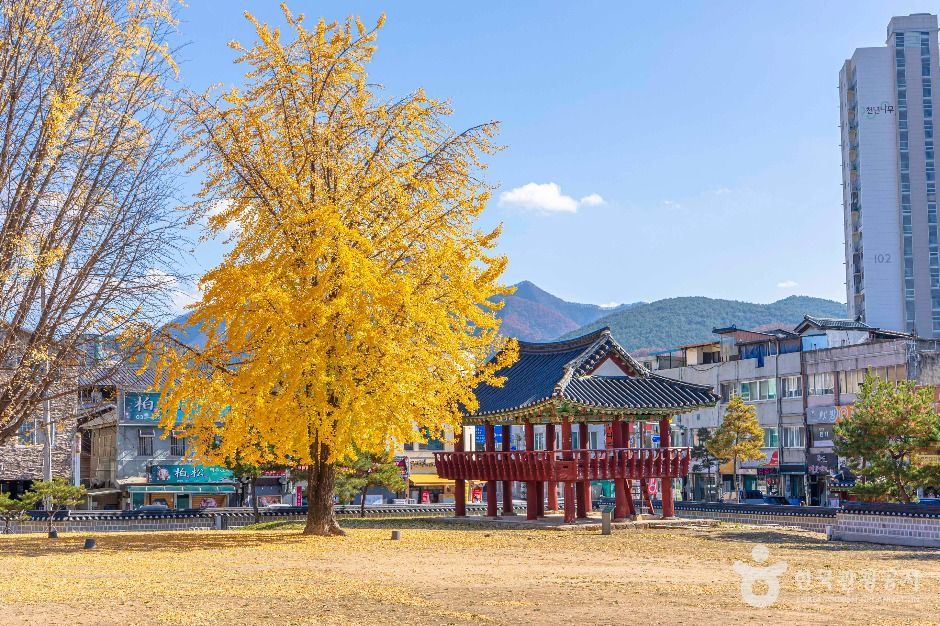
Jagyuru Pavilion and Gwanpungheon Hall
🌐 자규루 및 관풍헌
📍 61 Jungang-ro, Yeongwol-eup, Yeongwol-gun, Gangwon-do
Introduction
Gwanpungheon Hall was used as a magistrate’s office to handle local affairs during the Joseon Dynasty. The site consists of an annex and a 3x3 kan building (a traditional Korean structural unit). Currently, it serves as a mission center for the Bodeoksa Temple of the Jogye Order of Korean Buddhism.
About 50 meters away from the hall is Jagyuru Pavilion, where King Danjong (r. 1452–1455) stayed during his exile after losing the throne to King Sejo (r. 1455–1468). It is said that Danjong frequently visited this pavilion to write poetry known as jagyu poetry. In these works, he compared his own grief to the blood-spitting cries of the jagyu (oriental scops owl), a bird characterized by its painful and mournful call. The pavilion was originally built by County Magistrate Shin Kwon-geun in 1428 (the 10th year of King Sejong's reign) and was initially called Maejungnu. It was renamed after Danjong wrote his famous poems there. The buildings were eventually lost and forgotten until they were rediscovered and restored by Gangwon Provincial Governor Yun Sa-guk in 1791 (the 15th year of King Jeongjo's reign).
(Source: National Heritage Administration)
About 50 meters away from the hall is Jagyuru Pavilion, where King Danjong (r. 1452–1455) stayed during his exile after losing the throne to King Sejo (r. 1455–1468). It is said that Danjong frequently visited this pavilion to write poetry known as jagyu poetry. In these works, he compared his own grief to the blood-spitting cries of the jagyu (oriental scops owl), a bird characterized by its painful and mournful call. The pavilion was originally built by County Magistrate Shin Kwon-geun in 1428 (the 10th year of King Sejong's reign) and was initially called Maejungnu. It was renamed after Danjong wrote his famous poems there. The buildings were eventually lost and forgotten until they were rediscovered and restored by Gangwon Provincial Governor Yun Sa-guk in 1791 (the 15th year of King Jeongjo's reign).
(Source: National Heritage Administration)
Homepage
www.khs.go.kr
🗺 Location
61 Jungang-ro, Yeongwol-eup, Yeongwol-gun, Gangwon-do
🔎 Information
Inquiries
+82-33-370-2140
Parking Facility
Available (Free)
Closed
N/A (Open all year round)
Opening Hours
Open 24 hr
![Yeongwol Jangneung Royal Tomb [UNESCO World Heritage] (영월 장릉(단종) [유네스코 세계유산])](http://tong.visitkorea.or.kr/cms/resource/94/3557194_image2_1.JPG)